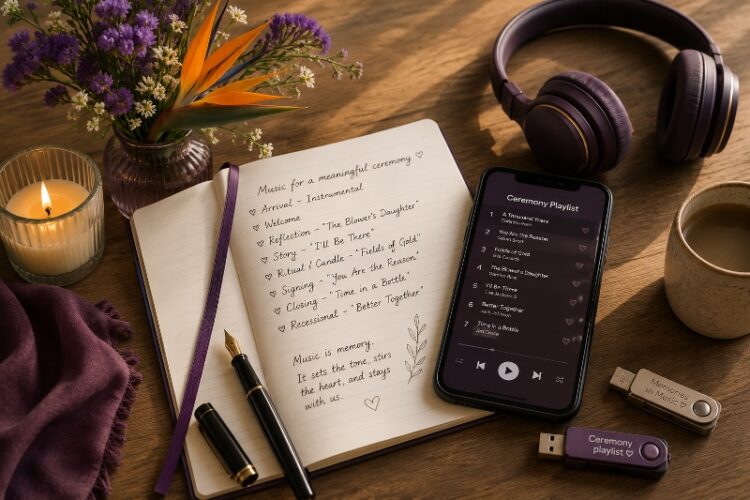
Choosing music for your ceremony is more important than people realise. It is a very important element in creating an effective service.
When people picture their ceremony, they usually picture the words ~ the vows, the readings, the moment they’re pronounced married or the moment a name is given. What they don’t always picture, until we start planning together, is the music. And yet, it’s often the music that people remember most vividly afterwards. The song playing as someone walks down the aisle. The quiet piece during a candle lighting. The joyful burst of sound as a couple walks back out as newlyweds.
As a non-religious celebrant, I spend a lot of time helping people find music that says what they can’t quite put into words. Here’s what I’ve learned about getting it right.
Why Music Matters More Than People Expect
In a non-religious ceremony, there’s no set liturgy, no hymn book to fall back on. That’s a gift ~ it means every element of the ceremony can be chosen deliberately, to reflect the people it’s actually for. Music is one of the most powerful tools for doing this.
It sets the mood before a single word is spoken. It paces the emotional journey of the ceremony, moving guests from anticipation, to intimacy, to celebration. And it marks transitions — a change in music tells guests, on an almost instinctive level, that something significant is about to happen, even before they consciously register it.
I once worked with a couple who couldn’t agree on a processional song for weeks. When we finally found the right one, an instrumental cover of a song from the film they’d watched on their first date, the bride’s mother told me afterwards it was the moment she finally cried. That’s the kind of effect music has. It does the emotional work that speech sometimes can’t.

The Key Moments That Usually Need Music
Most ceremonies have a handful of moments where music naturally belongs:
- Prelude, as guests arrive: this sets the tone before the ceremony even begins;
- The processional, when the couple, wedding party, or family enters and perhaps the coffin;
- A quiet moment, such time for reflection during a memorial service;
- The recessional, as the newly married couple (or family) exits;
- Optional interludes: during a reading, a candle lighting, or a tribute to someone who couldn’t be there.
Not every ceremony needs music in all of these places, but knowing where the natural pauses and transitions fall helps you decide where music will have the most impact.
The Practical Side
Choosing the right song is only half the job. Making it work on the day is the other half.
Think about the venue’s acoustics and equipment early. A beautiful acoustic guitar piece falls flat if there’s nowhere to plug in a speaker, and outdoor ceremonies especially need a proper sound check beforehand.
Timing matters more than people expect, too. A processional song needs to match the actual walking pace of the people entering ~ not too short that they’re rushing, not so long that they’re standing awkwardly at the altar waiting for the last verse to finish.
You’ll also need to decide between a live musician, a curated playlist, or a mix of both, and factor that into your budget early rather than as an afterthought. And if you’re planning to record or livestream the ceremony, it’s worth checking music licensing ~ some popular songs aren’t cleared for public broadcast, even at a private event.
Choosing Music That’s Actually Yours
The best ceremony music strikes a balance between personal meaning and something your guests can connect with emotionally, even if they’ve never heard the song before.
Consider whether you want lyrics or instrumental pieces. Lyrics can add enormous meaning when they say exactly what you feel ~ but they can also pull focus if guests are listening to the words instead of watching the moment unfold. Instrumental versions of meaningful songs are a popular middle ground.
If you’re blending cultures or family traditions, music is a beautiful way to represent both. I worked with one couple who chose two processional songs ~ one reflecting each of their heritages ~ and alternated between them as each side of the family entered. Guests told me afterwards it was one of the most moving parts of the day, because it visibly honoured both families without either feeling like an afterthought.
Common Mistakes to Avoid
A few pitfalls come up again and again:
- Not reading the lyrics of the song properly and then discovering on the day that they are actually inappropriate;
- Choosing a song that’s technically beautiful but carries an association you’ve forgotten about ~ like an ex’s favourite song, or a track associated with a funeral;
- Picking something far too long or too short for the moment it’s meant to fill;
- Leaving the final decision until the week before, when there’s no time left to test it;
- Skipping the sound check, and finding out on the day that the venue’s speakers can’t handle it.
Almost all of these are avoidable with a little planning, which brings me to the process I actually walk couples and families through.

A Simple Process for Choosing Music for Your Ceremony
- List your key moments: work out where in the ceremony music will actually be needed.
- Brainstorm freely: write down every song with personal meaning, even ones that seem unlikely.
- Narrow it down: for each moment, ask whether the song’s tone and pace actually fit.
- Test the timing: play it against the moment it’s meant to accompany (walk the processional length, time the unity ritual).
- Confirm with your celebrant or musician: make sure everyone involved knows the final running order well before the day. Do not leave it to the last moment to decide.
Examples of Unfortunate Choices of Music
A family wanted to play a piece of music during a memorial service for their mother. Without discussing it with me beforehand, they chose “Seasons in the Sun”. This turned out to be an unfortunate choice. Firstly, it’s about the singer, not the person being mourned. The lyric is written entirely in first person, from the perspective of a dying man. He is addressing people in his own life ~ it had nothing to do with the woman whose life we were celebrating. The sentiment is extremely sad and did not bring comfort to the mourners at all. In fact it made their grief even more acute.
Another example of someone not listening properly to the lyrics of the song was a wedding couple choosing the David Bowie song “Heroes” as the bride’s entrance song. It starts off appropriately:
I, I will be king
And you, you will be queen.
However, the chorus goes on with:
Though nothing, nothing will keep us together
We can beat them forever and ever
Oh, we can be heroes, just for one day
This is hardly what you should be thinking as you commit yourself to each other for the rest of your lives!
Closing thoughts
Music has a remarkable ability to express what words alone often cannot. Whether your ceremony marks a farewell, a wedding, a baby naming or another important life milestone, the right music helps create an atmosphere that reflects your values, your emotions and your story.
There are no rules about what you should choose ~ only the opportunity to select music that feels authentic and meaningful to you. When every element of a ceremony is chosen with care, including the music, it becomes more than an event; it becomes a lasting memory for everyone who shares it.
Contact Vanessa for assistance with your non-religious ceremony.
Frequently Asked Questions
-
Can we include religious music in a non-religious ceremony?
Absolutely. A non-religious ceremony is about reflecting the wishes, beliefs and personalities of those involved. If a particular hymn or religious piece holds special family memories or emotional significance, it can certainly be included, even if the ceremony itself is not religious.
-
How many songs should we choose for a non-religious ceremony?
There is no fixed number, but most ceremonies include between three and six pieces of music. These are often used as guests arrive, during moments of reflection or symbolic rituals, while signing documents (for weddings), and as everyone leaves. Your celebrant can help you decide where music will have the greatest impact.
-
What if we can’t agree on the music?
It’s quite common for family members or couples to have different musical tastes. Try to focus on songs that have genuine meaning rather than simply choosing favourites. A balanced selection can reflect different aspects of a person’s life or a couple’s journey. An experienced celebrant can also suggest ways to include everyone’s preferences while creating a ceremony that feels cohesive and meaningful.