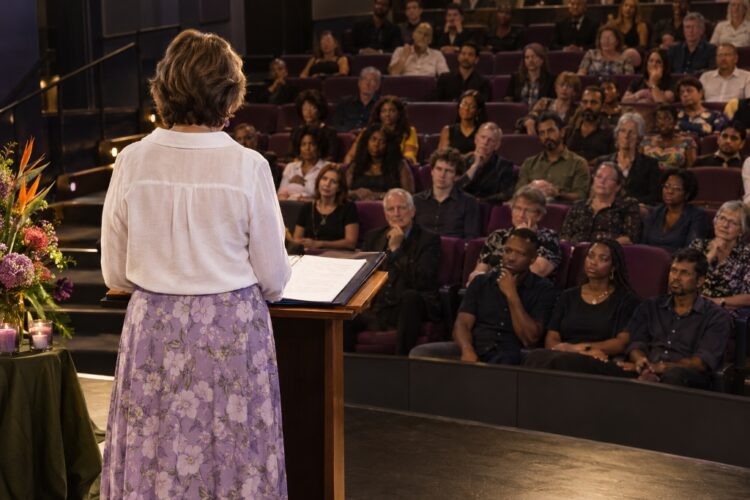
All funerals are difficult for the bereaved, but a funeral after suicide is particularly challenging for everyone concerned. Vanessa from Wordways Ceremonies has had to rise to this task on more than one occasion.
The situation
Early last year, Vanessa offered to officiate at the celebration of life ceremony for a young man who had succumbed to depression. He had no family in the town where he lived and his friends were having to make all the arrangements. There was the added complication that he had left behind a much-beloved dog.
The challenge in a funeral after suicide
The loss of a friend and loved one is always difficult to cope with, but a loss under these circumstances brings a complicated grief. One’s deep sorrow is compounded with other conflicting emotions, such as guilt, compassion, regret or even anger. Now is a time of “if only”, “maybe”, “perhaps”, “could have” or “what if”.
Although the young man openly acknowledged his struggles with depression, nobody could really have known what it was like for him.
The added challenge for the celebrant is to ascertain from the family, or in this case, the close friends, just how open they want the ceremony to be about the cause of death. In this case his friend did not want the celebrant to avoid stating that he had taken his own life. All who were present knew that this was a funeral after suicide.
Obviously the celebrant must be very sensitive in her wording , as there could be no hint of judgement of the actions of the deceased. Vanessa pointed out, “Nobody can read the mind of somebody about to contemplate taking his or her own life.”
The focus of the ceremony
At all of Vanessa’s celebration of life ceremonies, she does just that: she celebrates the life. His close relatives overseas sent quite a detailed description of his life, which made Vanessa’s job easier. What also made it easier was the fact that he had been an extraordinary young man. Physically he had been tall and speakers often used the word “towering.” He had a larger-than-life personality. He was highly intelligent and hugely talented as a performer and as a teacher.
As she told the story of his life, Vanessa was able to draw on a number of speakers, who had known him in different contexts of his life. Each of his friends gave more insight into him as a person, as well as his many achievements.

The venue
As he had been so involved in the performing arts, it was deeply appropriate that his friend had been able to arrange to hold the ceremony at a local performance venue.
A further deeply thoughtful touch was that his friend had brought along some of the shirts from productions he had directed at the schools where he had taught, which he hung on a wardrobe rail. He also brought a few of his friend’s books that were so precious to him. Those who attended were invited to go up after the ceremony to take something as a memento of the remarkable life that had been celebrated.
The music
The choice of music was particularly important as he was such a gifted singer. The music chosen for the ceremony was carefully selected from the pieces the deceased had loved.
Vanessa often suggests that families play a piece of music in the middle of the ceremony, to provide a time for reflection. She invites those present to think about the one who has passed and their relationship, what they admired and what they would miss about them.
One of the deceased’s past pupils asked to sing. His choice of song was deeply meaningful.
The closing song was taken from a famous fantasy film. The young man had been a great fan of fantasy literature and films.
The outcome
Vanessa was most gratified by the warm and very positive comments that she received after the ceremony. When someone says, “How did you know him?” she knows that she has presented an accurate portrait of the departed and the life that he led.
Conclusion
Families bereaved by suicide can face great difficulties, including stigma, guilt and uncertainty about how to talk about the death. Just know that help is at hand and you can turn to an experienced celebrant.